
Explore Slack’s SEO strategy and discover how the company built organic growth through product-led SEO, integrations, content clusters, and AI-era visibility.
TL;DR
- Slack doesn’t rely on blog content alone; it has turned its entire product ecosystem into a search acquisition engine.
- Its SEO strategy is built around integrations, product pages, use cases, and category ownership, not individual keywords.
- Every integration, feature, and solution page acts as a dedicated search asset that captures high-intent traffic.
- Slack’s visibility extends beyond Google through AI assistants, review sites, partner ecosystems, and third-party mentions.
- The biggest lesson: SEO is no longer about rankings alone. It’s about being discoverable wherever buyers search for answers.
Most SaaS companies think of SEO as a content function.
Publish blog posts. Rank for keywords. Drive traffic. Generate demos.
Slack takes a very different approach.
Rather than relying primarily on content marketing, Slack has turned its product ecosystem into a search acquisition engine. Integrations, feature pages, solution pages, workplace concepts, partner ecosystems, and third-party mentions all work together to create discoverability across Google, AI assistants, review platforms, and software marketplaces.
The result is a search strategy that supports category ownership, product adoption, enterprise demand generation, and brand authority simultaneously.
Let’s break down how Slack built that engine and what other B2B SaaS companies can learn from it.

What Slack’s Search Footprint Looks Like
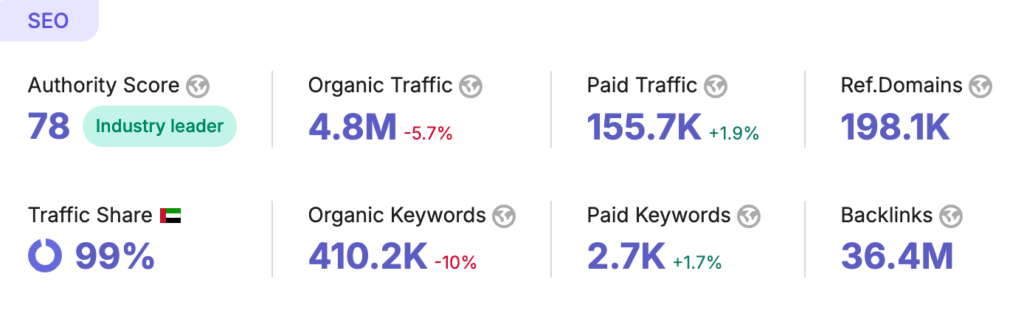
At first glance, Slack’s search visibility looks fairly conventional. The company benefits from strong brand awareness, a large content library, and rankings across thousands of keywords.
Look a little deeper, however, and a different picture emerges.
Organic Visibility
Slack’s organic traffic is distributed across multiple sections of the website rather than being concentrated in the blog.
Its visibility comes from a combination of:
- Product pages
- Feature-led content
- Integration pages
- Solution-focused landing pages
- Workplace terminology ownership
- Partner ecosystem pages
This allows Slack to capture users across multiple stages of the buying journey.
Someone searching for collaboration software may discover Slack through a category page. Someone researching workflow automation may encounter a feature page. Someone looking for a Salesforce integration may land on an integration page.
Each pathway is designed around a different search intent.
One of the strongest aspects of Slack’s SEO strategy is how it blends product education with product discovery. Its feature pages are not built purely to rank. They are designed to demonstrate value, explain capabilities, and guide users toward adoption.
As a result, Slack’s SEO program supports both visibility and revenue generation.
AI Search Visibility
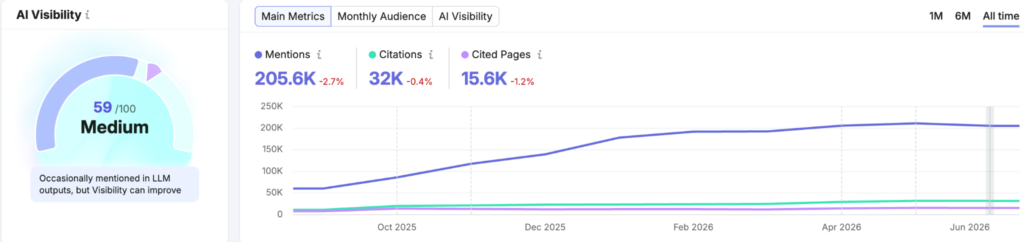
Slack’s visibility extends well beyond traditional search engines.
The company frequently appears in AI-generated recommendations related to workplace communication, collaboration, team messaging, and productivity software.
What’s particularly interesting is that Slack often appears even when users don’t explicitly search for the brand itself.
That’s because Slack has become closely associated with key workplace concepts. AI systems increasingly connect the brand with categories such as team communication, collaboration, workflow automation, and productivity.
The result is discoverability across both traditional search engines and emerging AI-powered search experiences.
More importantly, it demonstrates a broader trend: discovery no longer happens through a single channel.
Today, buyers discover products through search engines, AI assistants, software comparison sites, review platforms, partner ecosystems, communities, and third-party content.
Slack has built visibility across all of them.

The Business Goal Behind Slack’s SEO Strategy
Many SEO discussions start with keywords, rankings, traffic, backlinks, and content volume. But those are tactics, not strategy.
Before deciding which keywords to target, companies need to decide what role SEO should play within the business. Is the goal to:
- Drive product signups?
- Build brand awareness?
- Generate enterprise pipeline?
- Establish category leadership?
- Support customer education?
The answer shapes everything that follows.
Slack isn’t using SEO simply to attract traffic. It uses search as a scalable acquisition and education channel that helps potential customers discover the product, understand its value, and adopt it within their organizations.
Its SEO strategy appears to be designed around four core business objectives:
- Category Ownership: Slack wants to be associated with workplace communication and collaboration.
- Product Adoption: Search helps prospects understand the platform and how it solves specific problems.
- Enterprise Demand Generation: Solution pages and use-case content help attract decision-makers evaluating software options.
- Competitive Positioning: Slack strengthens its position within the broader collaboration software market by owning key conversations and concepts.
Rather than chasing keywords in isolation, Slack creates search experiences that support these business goals.
The Four Pillars Behind Slack’s Search Growth Engine
Here’s a deeper look into the key pillars of the Slack SEO strategy:
Pillar #1: Integration-Led SEO
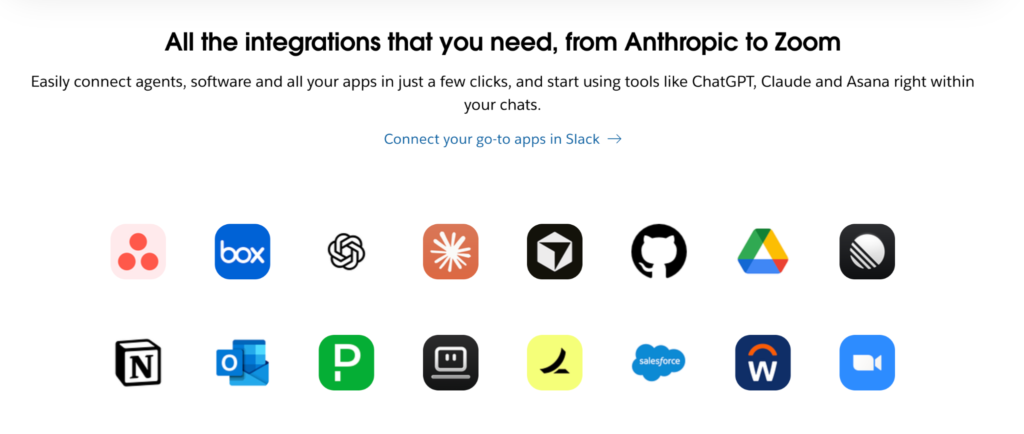
One of Slack’s biggest SEO advantages is its integration ecosystem.
The company has created dedicated pages for thousands of integrations, generating entry points for users searching for specific tools and workflows.
This allows Slack to capture highly relevant searches from users already evaluating how software fits into their existing stack.
Alongside broad collaboration terms, Slack ranks for searches connected to tools such as Salesforce, Jira, GitHub, Google Drive, and hundreds of others.
- Why It Works: Every integration becomes a new search asset. Each page expands Slack’s keyword footprint while attracting users with strong commercial intent.
- What SaaS Companies Can Learn: Look for scalable acquisition assets inside your product ecosystem. Integrations, templates, marketplaces, partner pages, and app directories often generate more qualified traffic than blog content alone.
Pillar #2: Product-Led SEO
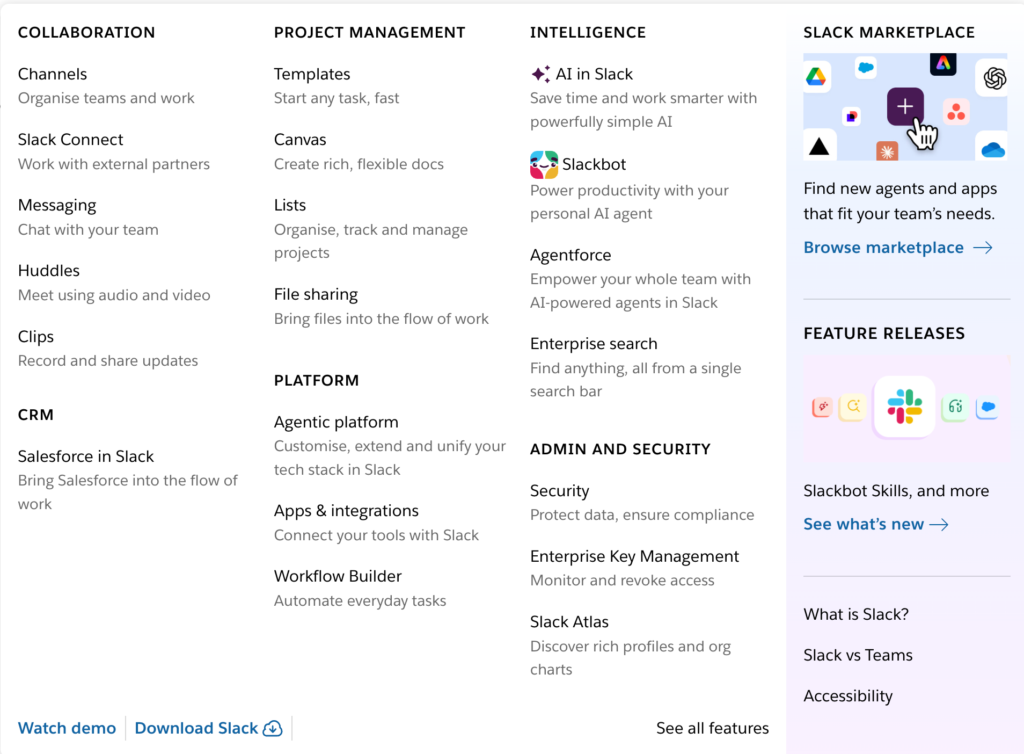
Slack has turned product features into discoverable search assets.
Feature pages target topics such as team communication, workflow automation, AI-powered productivity, and collaboration.
These pages sit much closer to the buying journey than traditional educational content. Instead of attracting visitors who are merely researching a topic, they attract visitors evaluating solutions.
- Why It Works: Product pages connect visibility directly to commercial intent.
- What SaaS Companies Can Learn: Your product should be one of your strongest SEO assets. Build pages around the problems your features solve, not just the features themselves.

Pillar #3: Category & Terminology Ownership
Slack doesn’t simply rank for workplace collaboration keywords.
It has positioned itself as one of the brands most closely associated with workplace communication, productivity, workflow automation, and collaboration.
This association strengthens visibility across both traditional search engines and AI-powered discovery platforms. The more frequently a brand becomes connected to a category, the more likely it is to appear when buyers search for solutions within that category.
- Why It Works: Owning a category creates visibility that extends far beyond individual keyword rankings.
- What SaaS Companies Can Learn: Focus on becoming associated with the concepts that define your market, not just the keywords that describe your product.
Pillar #4: Use-Case SEO
Many buyers search for problems before they search for products.
Slack addresses this by building content around workflows, business challenges, organizational needs, and workplace outcomes.
Rather than focusing exclusively on terms like “team communication software,” Slack also creates pages around:
- Improving collaboration
- Managing distributed teams
- Automating workflows
- Reducing communication bottlenecks
- Department-specific use cases
These pages allow Slack to connect its product to real-world business challenges.
- Why It Works: Use-case pages help Slack reach buyers before they begin comparing vendors.
- What SaaS Companies Can Learn: Build content around customer goals, workflows, and business outcomes; not just product categories.

Why Slack Performs So Well In Traditional Search
The pillars above are supported by a strong SEO foundation.
A Site Architecture Built Around Search
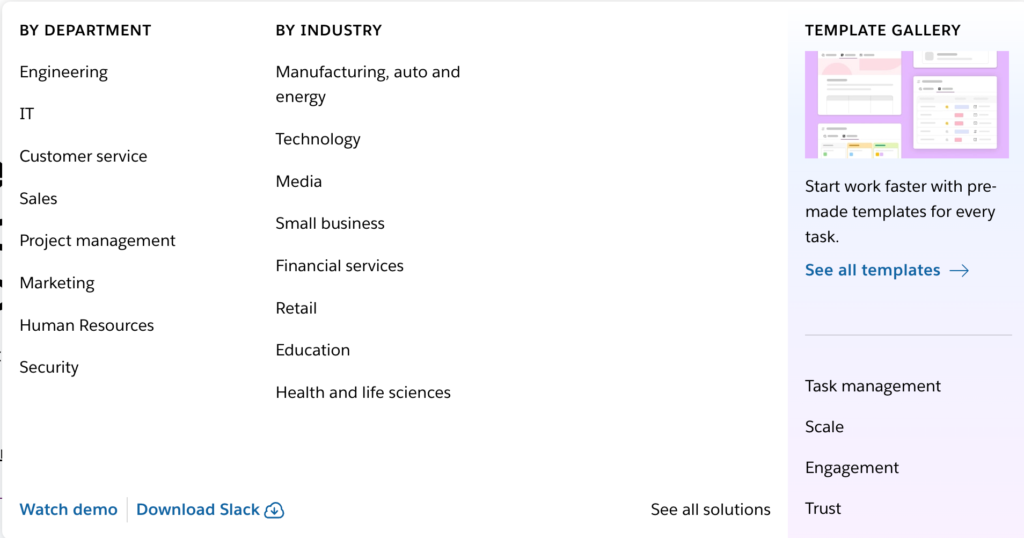
Slack’s content is organized into clearly defined sections such as Features, Solutions, Integrations, Resources, and Enterprise.
This structure makes it easier for both users and search engines to understand topic relationships.
Product & Landing Pages Do The Heavy Lifting
Many SaaS companies depend heavily on blog traffic. Slack distributes visibility across a large network of product-focused landing pages.
- Feature pages target commercial intent.
- Integration pages capture workflow-specific searches.
- Solution pages address business challenges.
Together, they create a search footprint that extends far beyond the blog.
Strong Internal Linking
Slack consistently links related pages together.
- Feature pages connect to solutions.
- Solutions connect to workflows.
- Educational content supports product pages.
This strengthens topical authority while helping users navigate naturally through the buying journey.
Topic Clusters That Reinforce Authority
Slack focuses on strategic themes such as workplace collaboration, productivity, communication, automation, and AI.
Multiple assets reinforce the same topics, helping Slack build deeper authority around concepts that matter to its business.
How Slack Wins In AI Search
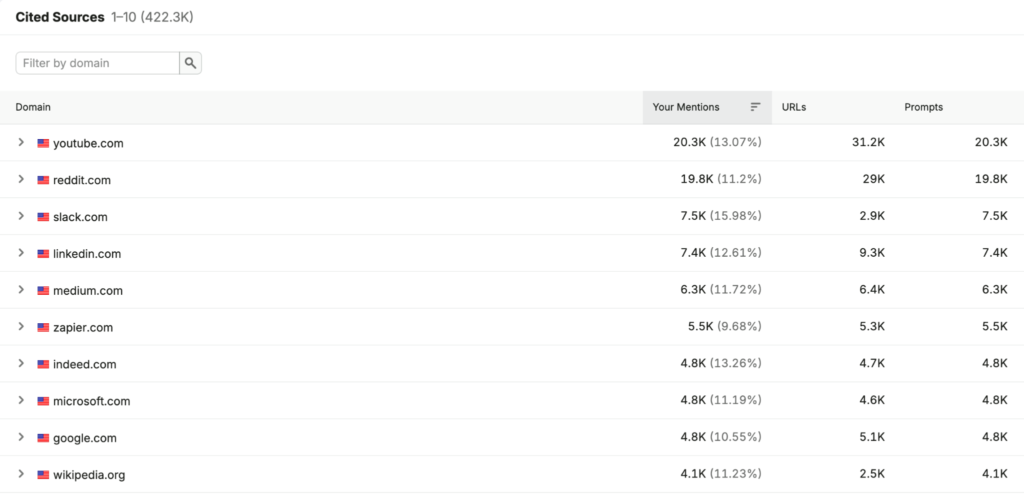
Traditional SEO and AI visibility are increasingly connected. Slack performs well in AI-generated recommendations because it has built authority that extends beyond its own website.
Strong Entity Recognition
Slack is one of the most recognized brands in workplace communication and collaboration. AI systems frequently associate the company with these concepts.
Authority Beyond The Website
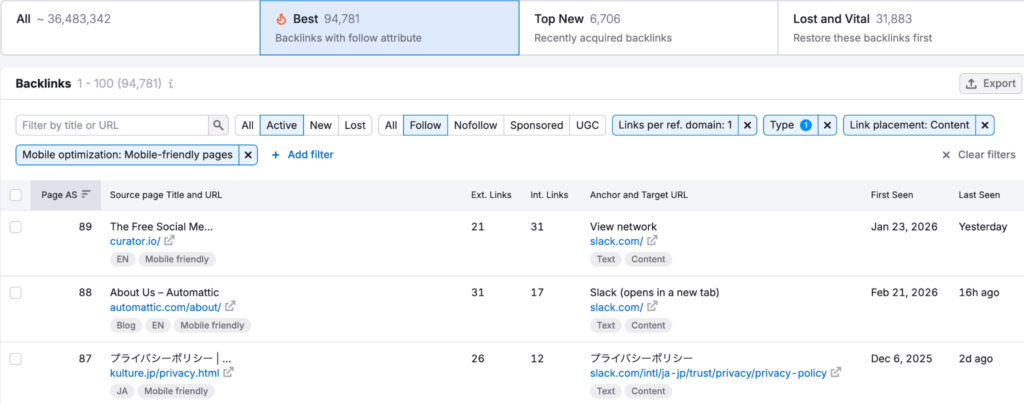
Slack maintains a strong presence across:
- Review platforms
- Software directories
- Media coverage
- Partner ecosystems
- Customer discussions
These external references reinforce credibility and visibility.
An Ecosystem Of References
Every integration page, customer story, partner listing, developer resource, review profile, and third-party mention creates another signal connecting Slack to its category. Together, these references strengthen discoverability across AI systems.
Citation-Friendly Content
Slack’s product, feature, and solution pages are built around clear explanations rather than marketing jargon. This makes information easier for AI systems to extract, understand, and reference.
Structured Information Architecture
Slack organizes content into clearly defined sections such as Features, Solutions, Integrations, Resources, and Enterprise. This helps AI systems understand how topics relate to one another and strengthens the likelihood of appearing in AI-generated responses.
Key Lessons From Slack SEO Strategy For SaaS Companies
Slack’s strategy offers several lessons for companies looking to improve both search and AI visibility.
- Turn Product Assets Into Search Assets: Integrations, templates, marketplaces, partner pages, and product features can become acquisition channels in their own right.
- Build Around Buyer Intent, Not Just Keywords: The strongest search strategies map directly to the customer journey.
- Own A Category, Not Just Rankings: Category association creates visibility that extends far beyond individual keywords.
- Create Content That Supports Evaluation: Buyers don’t just need educational content. They need help evaluating solutions.
- Build Authority Beyond Your Website: Review sites, partnerships, integrations, and third-party mentions increasingly influence discoverability.
- Think Of SEO As A Distribution System: The most effective SEO programs are not content engines. They are discovery engines.
SEO Strategy Lab’s Take
Slack’s visibility strategy reflects a much larger shift happening across search.
It’s easy to get distracted by the growing list of acronyms: GEO, AIO, SXO, VSO, and countless others.
Slack’s success shows that these aren’t separate disciplines. Its visibility is the result of building a product, brand, and ecosystem that can be discovered wherever buyers search for answers.
That’s why we believe the future belongs to Search Everywhere Optimization.
Not optimizing for individual platforms. But building enough authority, relevance, and presence to be found wherever your audience looks for answers.
Need help building our your search visibility strategy? Reach out to us.